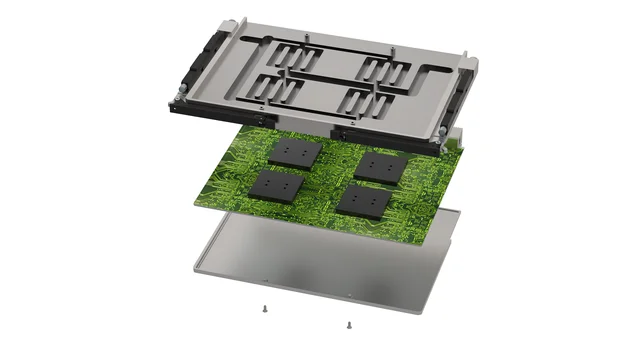
Precision Cooling for High-Performance Electronics
From heat management to thermal stability engineering
Electronic systems rarely fail suddenly—they drift. Small temperature deviations at the component level, uneven airflow, or localized hotspots gradually push systems away from their defined operating conditions. Over time, this thermal imbalance reduces performance, shortens component lifespan, and erodes reliability margins. By managing heat at its source and maintaining stable temperature profiles across the system, thermal behavior becomes predictable, testable, and reliable under real-world constraints.
The shift: from cooling to control
Instead of only addressing maximum temperatures, our cooling solutions focus on maintaining consistent thermal conditions that prevent performance drift over time. This enables systems to:
- Maintain stable performance under dynamic workloads
- Improve long-term reliability and operational consistency
- Designed for next-generation electronics
As power density increases and architectures become more compact, thermal management is no longer a support function—it is a system-level design parameter. Too Cool to Drift helps engineers design for thermal stability, not just cooling capacity.
APPROACH
Too Cool to Drift introduces a new approach to thermal design—moving from peak heat removal to long-term thermal stability engineering.
Targeted heat removal
The targeted heat removal focused approach improves overall system efficiency, enhances thermal stability, and helps maintain consistent performance under demanding conditions.
Controlled airflow paths
The controlled airflow paths optimised routing enhances convective heat transfer, improves cooling efficiency, and ensures more uniform thermal distribution across critical components, supporting stable operation in high-density environments.
Reduced temperature gradients
Reduced temperature gradients across critical components enable more uniform thermal distribution, minimising hotspots and improving heat dissipation.
Scalable air & liquid cooling integration
This enables seamless transitions as requirements evolve, supporting higher power densities with efficient thermal management.
SOLUTIONS
COOLING SOLUTIONS DESIGNED TO PREVENT DRIFT
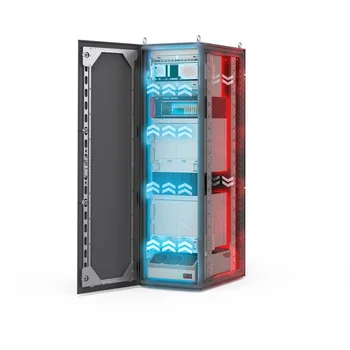
Subrack and Embedded Cooling
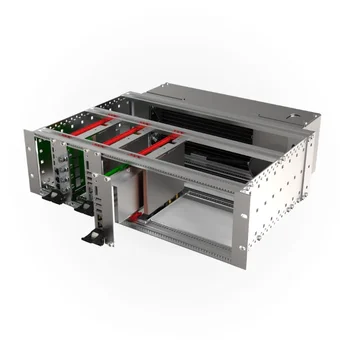
nVent SCHROFF offers targeted cooling for subrack and embedded systems through modular liquid flow through cold plates, fans and conduction cooling. Designed for space-constrained, high-density environments, these solutions give engineers flexible control over airflow and thermal performance.